
This article was written by COL (Ret) Sean Berg, Global SOF International Engagement Manager.
It is part of our series on the Indo-Pacific Irregular Warfare Symposium.
In 2022, a Chinese naval vessel docked in the Solomon Islands for the first time, marking the successful culmination of a five-year campaign of loans, infrastructure projects, and elite influence operations. Without firing a shot, China had secured a military foothold just 1,200 miles from Australia—territory that cost 7,100 American lives to secure in World War II.
How did this happen? While U.S. policymakers focused on traditional military concerns, China waged an irregular warfare campaign that systematically isolated Taiwan (now recognized by only 13 nations) and expanded Beijing’s strategic positioning throughout the Pacific.

The People’s Republic of China is winning a war most Americans don’t see. Their strategy systematically targets countries of strategic value through economic coercion, information manipulation, and elite capture—without triggering conventional military responses. This approach has yielded unprecedented results: control of critical ports and infrastructure across Africa and Asia, dominance in rare earth materials essential to U.S. defense systems, and the steady erosion of Taiwan’s international standing.
The Toll of WWII in the Indo-Pacific
In his WWII recollections, General Holland M. “H.M. Howlin’ Mad” Smith, Commanding General of the Pacific Fleet Marines, recounts in grisly detail the vicious, blood-strewn, puke-laden streak across the Pacific that was the innocuously labeled “island-hopping” campaign. Gen. Smith recounts the brutal arithmetic of strategic necessity, political indecision, and human sacrifice that starkly parallels today’s Irregular Warfare campaign and the unwillingness or inability to acknowledge the threat at hand.
The island hopping campaign would be more aptly called a chain of blood-soaked stepping stones. This 8,000-mile arc from Tarawa to Okinawa covers twice the distance from New York to San Francisco. In places most westerners would be unable to identify as existing, much less point to on a map, Smith’s Marines battle across the Gilberts (Tarawa, Makin), the Marshalls (Kwajalein, Eniwetok), the Marianas (Saipan, Guam, Tinian) and the one that most would recognize, the Volcano Islands (Iwo Jima).

Unlike European operations where troops could advance continuously, Pacific forces had to return thousands of miles to bases for resupply and prepare between operations. Consider the mountains of US provided military armament, weapons and supply that have sustained the war in Ukraine across the European land bridge. That was not an option to Gen. Smith and, hold your breath…there is no new land in that vast ocean now either.
The toll in human lives was simply staggering; numbers that modern political leaders would find impossible to contemplate:
Tarawa (76 hours of fighting): 990 Marines killed, 2,311 wounded
Saipan (24 days): 2,500 casualties in first 24 hours alone. Total Marine casualties exceeded 25,500 across the Marianas
Iwo Jima (26 days): 21,558 total casualties. 5,521 killed or died of wounds. One out of every three Marines who set foot on the island was killed or wounded
Smith believed and said, both before and after, to the Navy Admiral and Army General in command, that “Tarawa was a mistake.”
In reflecting on the brutal ratio Smith stated: “Never in the history of human conflict has so much been thrown by so many at so few,” yet the Japanese defenders exacted a terrible price for each yard of coral and volcanic ash.
Defending the Same Strategic Space Today
Smith’s account reveals how political timidity and inter-service rivalry nearly derailed victory. Gen. Smith had argued that the battle for Tarawa was entirely unnecessary and should have simply been bypassed. His Marine forces were habitually denied adequate Naval Gun Fire preparation as well as vessel support for the revolution in military affairs that was the development of amphibious warfare doctrine. Pacific and Washington, DC leaders consistently opted for flashy, but ineffective, Tokyo-focused operations.
At Iwo Jima, Smith’s request for 10 days of preliminary bombardment was cut to just 3 days. His chief of staff warned: “The naval gunfire support has been so weakened as to jeopardize the success of the operation… the cost in Marines killed will be far greater.”

The prediction proved accurate – inadequate bombardment led directly to higher casualties. Smith’s personal account reveals the crushing psychological burden of command:
“The man in the front line is blessed with a sense of immediacy… The general, however, knows far in advance what is to come and the picture is always there, spread before him. He goes into battle with the price of victory already calculated in human lives. This knowledge is a terrible burden, never to be shaken off, night or day.”
However, this critical understanding appears to be absent among strategic decision-makers, remaining largely unacknowledged even as the PRC deepens its influence and control across the 1st and 2nd island chains. The PRC is systematically connecting Oceania and the island nations, which provide the physical basis for Beijing to unilaterally declare the fictitious nine-dash line as a legitimate and sovereign boundary.
The island-hopping campaign required seizing physical territory through overwhelming force and sacrifice.
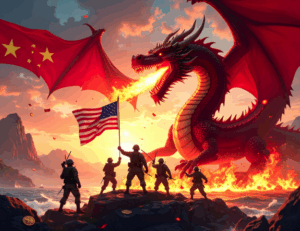
Today’s challenge involves defending that same strategic space through economic and political means. Where Smith had to capture islands with Marine blood, China’s Belt and Road Initiative seeks to capture them with economic dependency instead of military occupation; debt-trap diplomacy instead of naval bombardment; political influence operations instead of amphibious assault and infrastructure control instead of airfield construction.

The same strategic geography that cost America 15,000 Marine lives at Iwo Jima alone is now being contested through checkbooks and contracts rather than bullets and bombs.
Smith’s Marines paid in blood for every mile of ocean and every coral atoll. Today’s leaders must ask: Will we allow that sacrifice to be negated by our failure to recognize and counter economic warfare with the same strategic clarity and determination our predecessors showed in kinetic conflict?
The difference is that economic defeat can be harder to reverse than military occupation—and it comes without the galvanizing clarity of casualties that might force political action.
Join the Conversation
Register for the Indo-Pacific Irregular Warfare Symposium to participate in conversations focused on these topics and more…

Leave a Reply