

What Three Days of Connection Made Possible
This blog is about the GSE Symposium 2026.
06 – 08 oct 2026 | Rome, Italy
There is a different feeling around a hotel on the final morning of an event.
Suitcases begin appearing beside breakfast tables. Check-out questions replace jet-lag conversations. Business cards have been exchanged, phones are filled with new contacts, and the familiar espresso and cappuccino orders are accompanied by talk of flights, trains and the journey home.
But there was still work to do.
When we arrived in Rome three days ago, we asked a series of questions.
How do we work better together?
How do we improve interoperability?
How do we move capability faster?
How do we connect investment to genuine operational need?
And how do we build the relationships now that will matter when circumstances become far more difficult than anything we will face inside a conference room?
After three days of conversations, introductions, challenges and more than a few cups of very good Italian coffee, the final morning provided a fitting place to bring many of those threads together.
Because increasingly, the answer is not found inside one headquarters, one country, one company or even one sector.
It is found in the connections between them.
Speed Is Changing the Equation
One of the morning’s conversations returned to a subject moving faster than almost any other: artificial intelligence and autonomous technology.
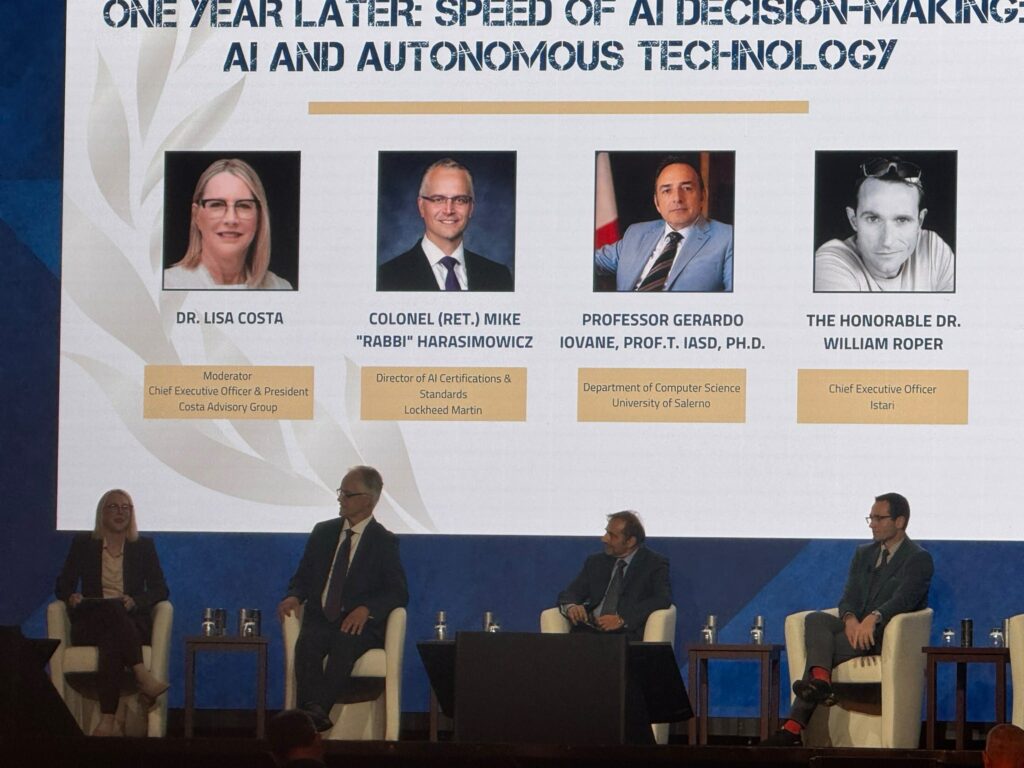
“One Year Later: Speed of AI Decision-Making: AI and Autonomous Technology” brought the discussion back to the pace at which technology is changing both the operating environment and the decisions required within it.
Among those contributing to the conversation were Dr. Lisa Costa, whose previous roles include Chief Technology and Innovation Officer for the U.S. Space Force and Chief Information Officer for U.S. Special Operations Command, and Colonel (Ret.) Mike “Rabbi” Harasimowicz, Director for Artificial Intelligence Certifications and Standards at Lockheed Martin.
Their backgrounds themselves reflect the breadth of the challenge: government, operational technology, industry, standards and implementation all have a role to play.
The question is no longer whether AI will influence military decision-making.
It already is.
The more difficult questions are about how quickly it can be integrated, how much confidence commanders can place in it, how standards keep pace with development, and how human judgment remains effective as the time available to make decisions becomes increasingly compressed.
For SOF, speed has always mattered.
But speed without understanding is not decision advantage.
The goal is not simply to make decisions faster.
It is to make better decisions faster, with the right information, the right technology and the right people connected at the point of need.
That distinction will only become more important.
Start With the Problem
From AI, the conversation moved naturally toward another theme that has surfaced repeatedly throughout this week:
Stop beginning with the solution. Start with the operational problem.
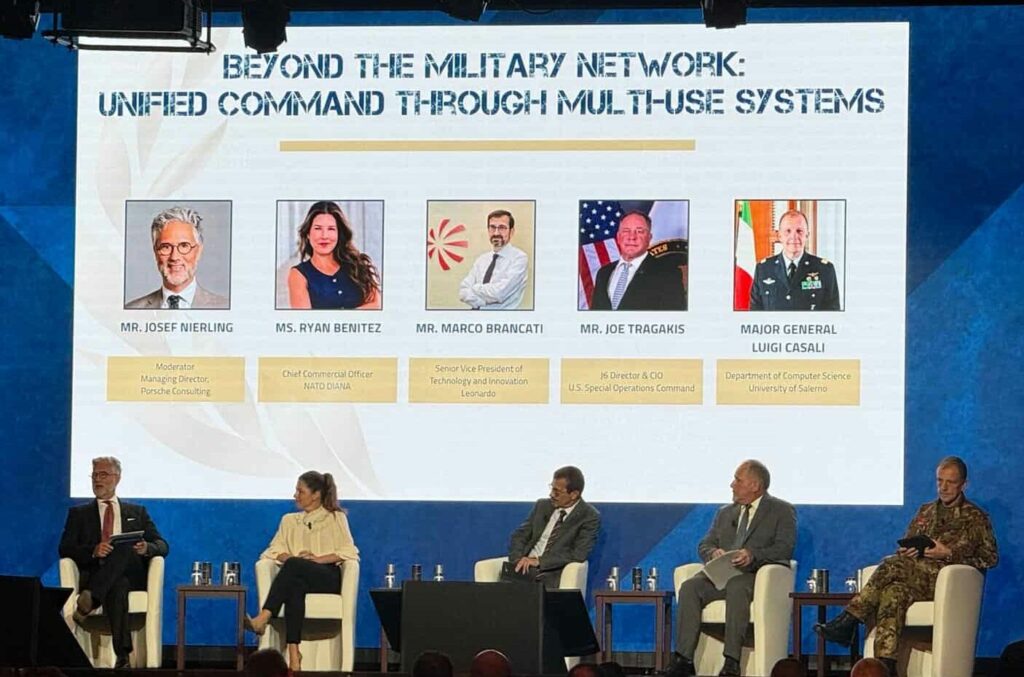
The session “Beyond the Military Network: Unified Command through Multi-Use Systems” examined what happens when many of the capabilities needed by modern forces are no longer developed exclusively inside traditional defense structures.
Commercial companies are moving quickly.
Startups are creating technologies with military applications long before they were designed for a defense customer.
Universities, research organizations and private investors are contributing to an innovation ecosystem far larger than the traditional defense industrial base.
That creates enormous opportunity.
It also forces defense organizations to think differently.
Rather than defining exactly what a future solution must look like and then asking industry to build it, a problem-centric approach begins with the warfighter need.
Here is the problem. Who can help us solve it?
That simple change opens the door to multiple possible solutions and to companies that may never previously have considered themselves part of the defense ecosystem.
Connecting the Warfighter to the Builder
That is where innovation accelerators such as NATO DIANA become particularly important.
Their role is not simply to find interesting technology.
It is to create a bridge between an operational problem and the commercial organizations that may be capable of solving it.
The warfighter understands the environment.
The entrepreneur understands what can be built.
The investor understands what can scale.
Government understands the requirement and the authorities.
None holds the complete answer alone.
Put them together, however, and the development cycle can look very different.
Commercial companies and startups can often iterate at a pace that traditional government development processes struggle to match. In some areas, by the time a capability has moved through a conventional development and acquisition cycle, the technology surrounding it may already have moved on.
The challenge therefore becomes not just how do we innovate?
It becomes:
How do we find innovation wherever it exists, rigorously evaluate it, adapt it to the mission and get it to the people who need it quickly enough to make a difference?
Innovation Requires More Than Technology
There is another side to that equation.
Bringing commercial technology into defense does not mean simply buying something and handing it to an operator.
The institution has to adapt too.
Warfighters need opportunities to work directly with developers.
Developers need to understand the realities of the operational environment.
Promising technologies need rigorous testing and vetting.
Command structures, acquisition processes and policies may need to change around them.
And increasingly, the people funding innovation also need to be part of the conversation.
Private capital, sovereign wealth funds and investors are showing greater willingness to support defense technology, giving startups access to the resources required to develop and scale faster.
We saw that investment conversation begin yesterday.
Today, the pieces came together even more clearly.
Operator. Builder. Government. Investor.
They are no longer separate conversations.
They are parts of the same capability pathway.
A Network Bigger Than the Military Network
Perhaps one of the most important ideas from the final morning was contained in the title itself.
Beyond the Military Network.
Future command and decision superiority will not depend exclusively on purpose-built military networks.
Capabilities may sit in commercial infrastructure.
Data may come from nontraditional sources.
Technology may originate in a university laboratory or startup.
Private companies may own systems that become critical to operations.
And allies may each bring different pieces of the overall capability.
Command and control therefore has to work across a much broader ecosystem.
That is a technological challenge.
But it is also a relationship challenge.
Because seamless systems mean very little without the trust, standards, agreements and human relationships required to use them together.
And in many ways, that brings us directly back to where we started this week.
More Than 1,000 Reasons This Matters
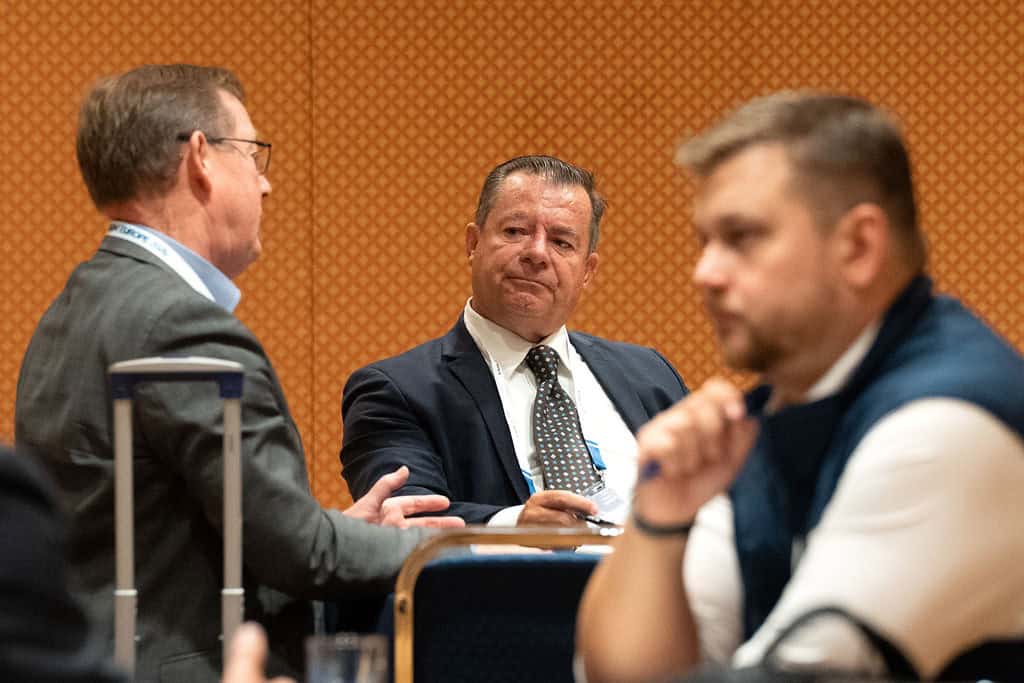
This has been a record GSOF Symposium Europe, with more than 1,000 attendees and 32 Partner Nations joining us in Rome across the week.
That number matters.
But what matters more is who those people were.
Operators.
Commanders.
International partners.
Government officials.
Industry.
Entrepreneurs.
Investors.
Academics.
Technology leaders.
People who arrived with very different responsibilities, experiences and perspectives, but who spent three days sharing the same rooms and many of the same problems.
In our opening blog, we wrote that the purpose of bringing different nations and organizations together was not to make those differences disappear.
It was to connect them.
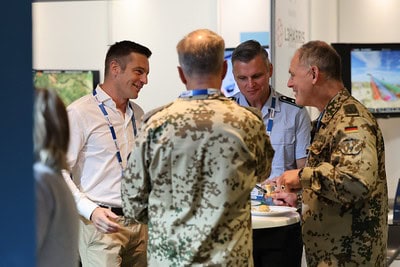
Walking through the Symposium this week, that connection has been everywhere.
It was visible in the general sessions.
It was visible in packed exhibition aisles.
It happened through CNECT.
It happened in government-to-government meetings.
It happened over coffee.
It happened during receptions overlooking Rome.
And, as always, some of the most valuable moments began with the simplest sentence:
“You need to meet this person.”
The Measure Comes Next
At the beginning of the week, we wrote something that feels even more important today:
The real measure of this Symposium would not be what happened while everyone was in Rome.
It would be what continued afterward.
Now we find out.
Does the introduction become a meeting?
Does the meeting become a partnership?
Does the operational problem find someone capable of solving it?
Does promising technology get evaluated, developed and ultimately fielded?
Does a conversation between two nations create greater interoperability?
Do the relationships built here make it easier to pick up the phone when something happens six months from now?
That is where the impact of these three days will be measured.
The stages will come down.
The exhibition stands will be packed away.
Badges will disappear into suitcases and more than 1,000 attendees will begin heading in different directions around the world.
But the network goes with them.
That was the point.
We arrived in Rome talking about unity and harmony of purpose.
We leave having seen what that can look like when commanders, operators, government, industry, investors and innovators are actually brought together around real problems.
A subtle nod, perhaps, to the Roman idea with which we began:
Concordia.
Not agreement on everything.
Not everyone doing the same thing.
But different people choosing to move with purpose in the same direction.
To everyone who joined us in Rome, grazie.
Thank you for the conversations, the challenges, the ideas and the willingness to connect.
Most importantly, thank you for being part of this community.
Safe travels home.
And keep the conversations going.
 From the Mediterranean to the Mission:
Leave a Reply